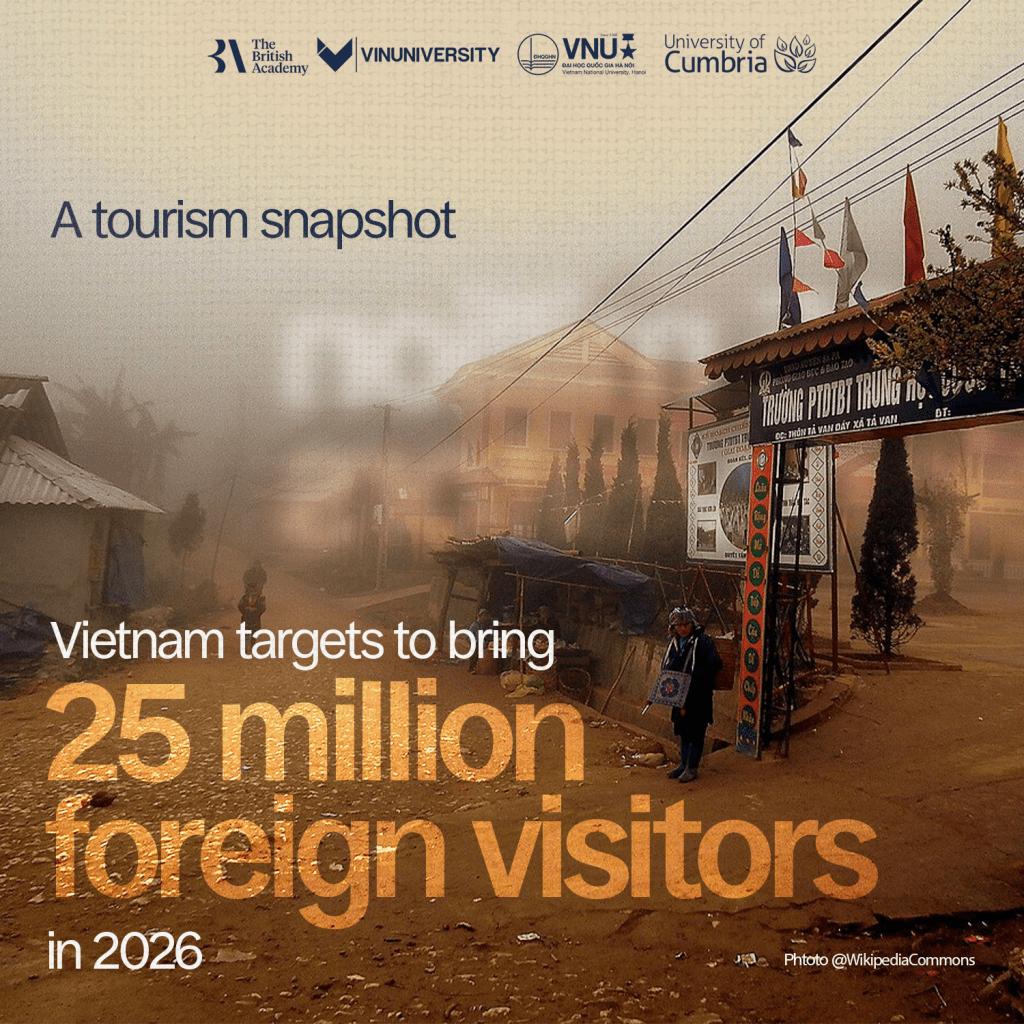
Tourism is rapidly growing in Vietnam. Can it meet the service demand?
The tourism industry in Vietnam is a significant contributor to economic development and has recently experienced massive growth specifically in the northern mountainous region. International and domestic travelers are drawn to the country’s natural beauty and deep cultural heritage. Vietnam, a country with a population of 101 million people (15th most populous in the world), also has rich cultural diversity consisting of fifty-three ethnic minorities (12% of population) such as the Tày, Thái, Mường, Hmong, Khmer and one ethnic majority the Kinh (88% of population) (General Statistics Office of Vietnam 2023). Northern Vietnam has rich biodiversity consisting of flora and fauna, rice terraces, and beautiful mountainous landscapes.
In Vietnam’s northern highlands, tourism is more than an economic opportunity and has reshaped foundational components of employment, income, homes, relationships, and self-perception. This is especially true for the ethnic minority communities such as the Hmong, Giay, and Dao. Tourism demand is transforming the very work, culture, infrastructure, and daily lives of locals. In the process, this demand may reshape what it means to live and belong in places previously known only for their remoteness.
Eight kilometers from the bustling Sa Pa town lies a small village named Tả Van, promoted as an “authentic” alternative away from the already commercialized center. Tả Van Village is one such location that has seen rapid development and is being shaped by heavy tourism demand. First settled by the Giay ethnic people about 300 years ago, it is now home to Hmong, Giay, and Red Dao minorities. For most of the 20th century, Tả Van remained isolated. However, when Sapa began attracting international and domestic tourists from the mid-1990s onwards, Tả Van was gradually integrated into trekking and “adventure” tourism routes. Tourism expanded further in the 2000s as the government improved road access, and non-governmental organizations (NGOs) and development groups actively trained locals in hospitality, English language, and service skills to foster community-based tourism (CBT). Today, Tả Van is dense with homestays, cafés, and trekking services. With a population of approximately 1,000 residents, Tả Van Village can be seen as a “microcosm” of highland tourism, making it a manageable yet rich case for understanding changes associated with tourism. In these posts, we will explore “tourism cases” such as Tả Van sharing stories from locals, agencies, and tourists.
Author: Myles Lynch
 Vietnam Outdoor Tourism Research