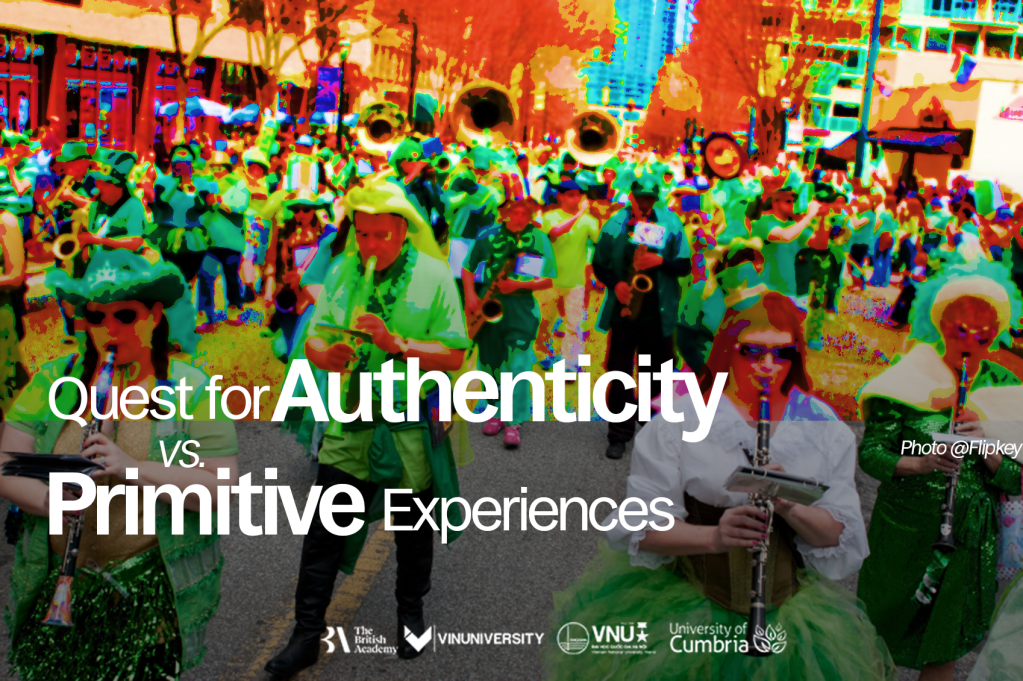
In recent years, concepts such as authentic tourism, primitive tourism, and community-based tourism have become increasingly popular since many travelers are motivated to understand, to connect with real culture, real history, and real everyday life. This trend is closely tied to broader social conditions. In modern societies, where social relationships are increasingly loose and impersonal, authenticity, intimacy, and closeness are often seen as the foundations of social solidarity. Keywords such as authentic, local, and community-based tourism therefore become especially attractive, as they promise tourists a chance to “see life as it is really lived,” or even to “live with the locals.”
From a dramaturgical perspective, Erving Goffman (1959) described social life as a theatrical performance with the fontstage refers to spaces where individuals present themselves to the public, backstage to spaces where they can relax their performance and know that no one is looking. Building on this framework, Dean MacCannell developed the concept of staged authenticity, arguing that tourists often seek access to backstage spaces because they believe these spaces contain genuine authenticity and real intimacy. Knowing that, tourist settings are carefully organized to give the impression that backstage spaces truly exist and can be accessed – although in reality, this is rarely the case (MacCannell,1973). Many tourism models promote themselves as “primitive,” “local,” or “authentic,” leading to ongoing negotiations over what counts as authenticity.
To explain this process, MacCannell outlines six stages along a continuum from frontstage to backstage, ranging from spaces entirely designed for tourist display to the true back region described by Goffman – spaces that are genuinely private and largely unreachable. In practice, tourists usually move only within intermediate zones, where frontstage areas are decorated to resemble backstage spaces, or where backstage areas are selectively opened under controlled conditions.
As a result, authenticity in tourism is not a clear-cut distinction between real and fake, but something that is performed through these intermediate spaces, or stage settings. Tourist experiences therefore unfold along a continuum between frontstage and backstage, rather than through a strict opposition. Rather than escaping tourism, tourists often become trapped within the very tourism spaces they seek to move beyond.
However, this does not mean that tourists are victims of deception. Understanding staged authenticity allows tourists to recognize that not all aspects of everyday life are available or appropriate for public display. This awareness can free tourists from an endless “authenticity chase” and shift attention away from uncovering hidden backstages toward engaging more reflectively with what is offered.
In contemporary tourism contexts shaped by social media, destination branding, and experience-driven marketing, staged authenticity raises critical questions about power and representation: Who defines what counts as “authentic”- tourists, service providers, or host communities? Whose interests are prioritized in these performances, and which voices, practices, or lived realities remain excluded or invisible?
_
Author: Thuy Duong (Jenny).
Photo Credit: @Flipkey
_
References:
MacCannell, D. (1973). Staged Authenticity: Arrangements of Social Space in Tourist Settings. American Journal of Sociology, 79(3), 589–603. http://www.jstor.org/stable/2776259Goffman, E. (1959). The Presentation of Self in Everyday Life. Anchor Books.
_
Vietnam Outdoor Tourism Research Project
💌Email: vietnamoutdoorresearch@gmail.com
🌐Website: https://vnort.com/
 Vietnam Outdoor Tourism Research