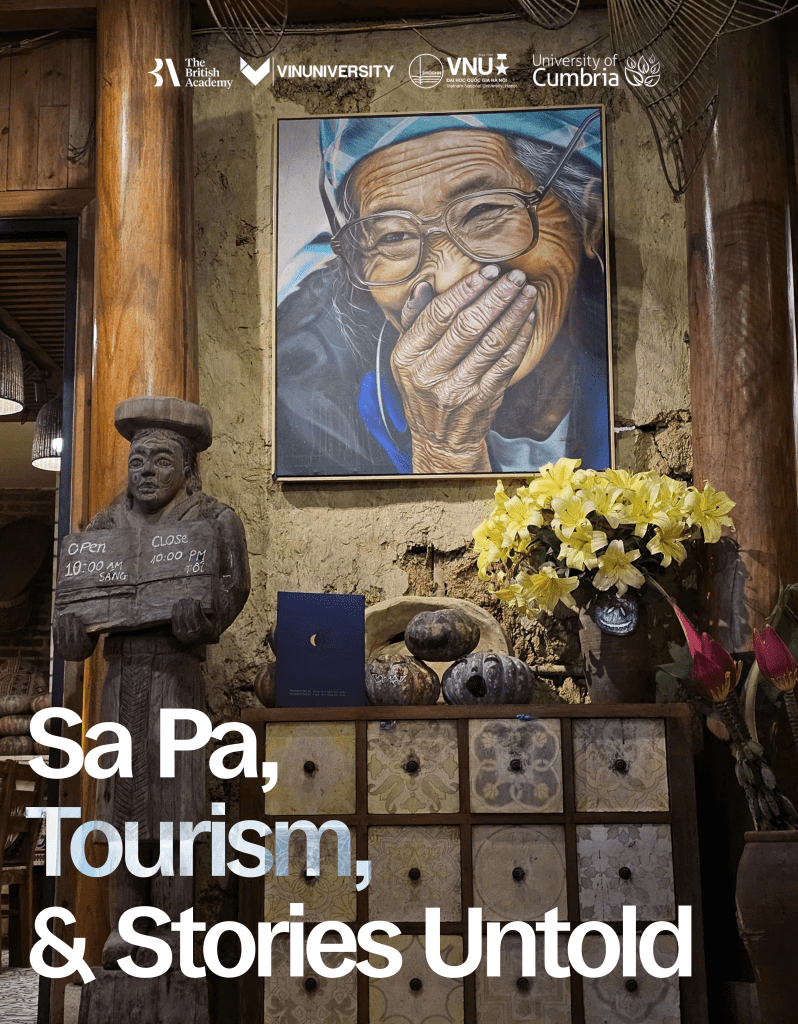
More than twenty years ago, Sa Pa entered a period of rapid investment and transformation, marked symbolically by the celebration of “100 years of tourism” at this highland destination (1903–2003). It was at this critical moment that Jean Michaud and Sarah Turner (2006) documented, with sharp ethnographic insight, their field observations of Sa Pa in transition. Their study examines how tourism has been reshaping the cultural landscape of the Northwest highlands, and how tourism discourses are produced, contested, and imposed upon the mountain cultural space of Sa Pa. Two decades later, the issues raised in their article remain strikingly relevant for contemporary reflections on highland tourism and its relationship with ethnic minority communities such as those in Sa Pa.
The rise of dominant visions…
Michaud and Turner show that around the centennial milestone of Sa Pa tourism (1903–2003), the town was actively being remade as a “second Đà Lạt,” complete with artificial lakes, concrete walkways, and manicured gardens. Local authorities and lowland investors prioritized a form of “sanitized nature,” in which ruggedness and ecological complexity were pushed aside in favor of convenience, order, and modern comfort.
More importantly, the study convincingly demonstrates that tourism in Sa Pa does not operate as a neutral process. Rather, it is driven by “contending visions” held by different groups of actors. Local authorities and business interests view tourism as a fast track to economic growth, emphasizing infrastructure development and the creation of landscapes that are “clean, attractive, and easy to consume.” From the visitors’ side, middle-class tourists from the lowlands come to Sa Pa seeking a cool climate, safe relaxation, and neatly staged “cultural fragments.” International tourists (especially backpackers) tend instead to pursue “authenticity,” hoping to encounter ethnic minority communities and rural lifeways. Notably, however, Hmong and Dao communities, despite constituting the majority of the local population, have little power to shape the tourism narratives constructed about their own living environment.
…and the performance of cultural fragments
From these layered and often conflicting expectations, Michaud and Turner advance a particularly sharp argument: in tourism, representation often prevails over reality. Local cultures are selectively curated, thinned out, and framed as performances—such as the “love market” or “cultural villages”—that are visually appealing and commercially viable, yet detached from lived social realities. This constitutes a form of selective preservation, in which what is “beautiful, exotic, and harmless” is retained, while complex, dynamic, and sometimes uncomfortable aspects of everyday life are excluded.
Michaud and Turner therefore warn that tourism growth does not automatically translate into sustainable development. Without meaningful participation by local communities, tourism can deepen inequality, erode indigenous knowledge, and transform living culture into a mere “performative resource.” For highland tourism in Northwest Vietnam today, these warnings remain highly pertinent.
Sustainable development, in this sense, is not simply a matter of beautifying landscapes or expanding infrastructure. At its core, it requires safeguarding communities’ rights to tell their own stories, and beginning with the transfer of narrative authority and stewardship over cultural and landscape resources back to local people themselves. The study thus poses a question that remains pressing today: do the new “cultural discourses” that rapidly proliferate alongside tourism development genuinely support the flourishing of ethnic minority communities, or do they merely turn them into spectators on their own land?
_
Author: Trần Hoài
Photo Credit: Taken by Trần Hoài
_
Reference
Michaud, J. and Turner, S., 2006. Contending visions of a hill-station in Vietnam. Annals of Tourism Research, 33(3), pp.785-808.
_
Vietnam Outdoor Tourism Research Project
💌Email: vietnamoutdoorresearch@gmail.com
🌐Website: https://vnort.com/
 Vietnam Outdoor Tourism Research