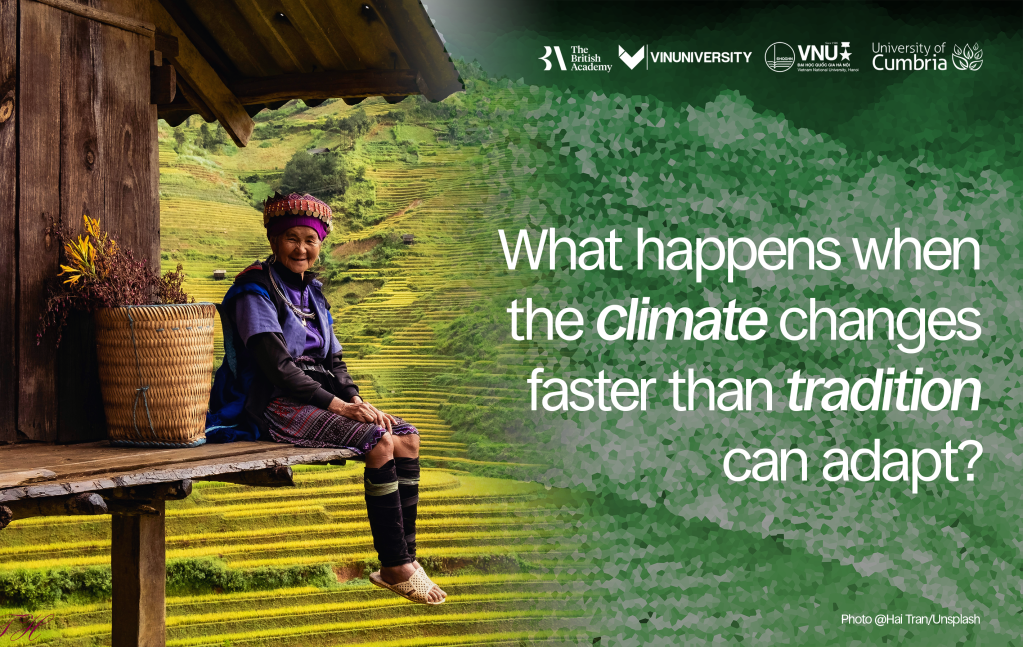
In the mountains of Bắc Kạn, knowledge has long been read in leaves, insects, and river moss. When a forest flower blooms for two days with a distinct fragrance, rain is expected. When ants climb the pillars of a house, a storm is near. When certain trees begin to bud, it is time to transplant rice.
In their study of Tay communities in the Northern mountainous region of Vietnam, Hoa et al. (2021) document a complex system of indigenous knowledge that guides agricultural production and climate adaptation. Crops are not chosen only for yield but for resilience and historical continuity. Hilly sticky rice, native beans, black pigs, and local fish varieties are cultivated because they endure drought, resist disease, and align with seasonal rhythms shaped over generations. Forecasting is not abstract; all is embedded in daily observation and collective experience.
At the same time, the research complicates celebratory narratives of indigenous resilience. Rising temperatures, prolonged droughts, extreme cold spells, and new pest pressures are reducing yields and increasing agrochemical use. Households respond by diversifying their livelihoods, male out-migration, and intensified forest product collection. Notably, the burden of adaptation increasingly falls on women, who assume expanded agricultural responsibilities. Indigenous knowledge continues to guide practice, yet the speed and severity of climatic change exceed its adaptive range.
The paper, therefore, invites a different analytical lens. Knowledge here is dynamic and deeply grounded in lived practice, yet it is also vulnerable to structural pressures. The authors caution against treating it as self-sufficient. What emerges is not simply a narrative of loss, but one of negotiation between knowledge systems under accelerating environmental stress.
For our broader inquiry into changing cultural narratives in Tây Bắc, this raises an important consideration. Indigenous knowledge is often framed in tourism discourse as heritage, stable, and timeless. But what if it is better understood as a living infrastructure under pressure, continually adjusting to ecological and economic uncertainty?
If culture is already adapting in response to climate change, how might our interpretations shift when we foreground adaptation rather than preservation?
_
Author: Nhi Nguyen Song
Photo Credit: Hai Tran (Unplash)
Reference:
Hoa, H. T., Son, H. N., Kingsbury, A., Chi, D. T. L., Tam, N. V., & Phan, D. V. (2021). The role of Tay indigenous knowledge in climate change adaptation in the Northern Mountainous Region of Vietnam. Indian Journal of Traditional Knowledge (IJTK), 20(2), 459-472. 10.56042/ijtk.v20i2.26058
_
Vietnam Outdoor Tourism Research Project
💌Email: vietnamoutdoorresearch@gmail.com
🌐Website: https://vnort.com/
 Vietnam Outdoor Tourism Research