In the previous article about staged authenticity, we discussed tourists’ quest for authentic tourism experiences, the recent rise of authenticity as a trend, and the difficulty of uncovering hidden backstages. However, this dominant focus on authenticity often leads to a simplified assumption: that staged authenticity is merely a form of performance that undermines cultural integrity. This article offers another lens to reconsider that assumption.
Based on Erving Goffman’s idea of frontstage and backstage and Dean MacCannell’s concept of staged authenticity, tourism is frequently interpreted as a staged performance in which destinations present curated cultural images for tourists. From this perspective, staged authenticity is seen as something artificial that degrades original culture and turns indigenous practices into commodified spectacles. Yet this interpretation rests on a binary logic between “real” authenticity and “staged” authenticity, which may be too rigid for understanding how tourism actually functions.
Scholars such as Erik Cohen (1988) challenge this binary view by arguing that the staged authenticity does not inevitably destroy original culture. Instead, cultural meanings do not simply vanish; they may persist, although sometimes in less visible or transformed forms. Similarly, Edward Greenwood (1982) suggests that cultures are constantly in the process of “making things up.” This means that culture is not fixed, but rather it is dynamic, adaptive, and continuously reproduced. If culture itself is always evolving and partially constructed, then the presence of staged elements in tourism should not be seen as a part of an ongoing cultural process. This shifts the discussion from asking whether an experience is purely authentic to examining how authenticity is perceived and negotiated by tourists.
Sarah et al. (2022) find that the staged authenticity of recreated historical tourism experiences has a significant positive relationship with visitors’ attitudes. Their study, based on interviews with 30 tourists and an online survey of 629 participants in Australia, shows that tourists do not uniformly reject staged authenticity. Rather than passively consuming or dismissing staged experiences, tourists actively interpret them and assign meaning depending on their expectations and personal interests.
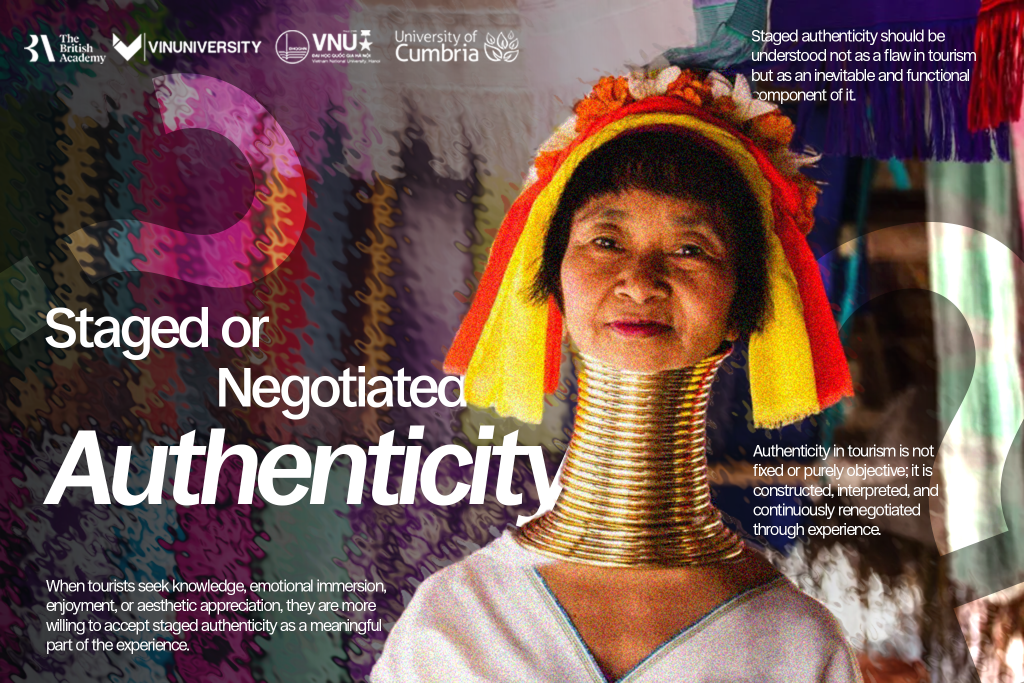
More specifically, demographic factors and individual interests, such as engagement with arts, culture, religion, and even dark tourism, play a crucial role in shaping how staged experiences are perceived. In addition, experiential dimensions including education, entertainment, escapism, and aesthetics have a positive relationship with visitor attitudes. When tourists seek knowledge, emotional immersion, enjoyment, or aesthetic appreciation, they are more willing to accept staged authenticity as a meaningful part of the experience.
This leads to an important implication for heritage tourism development. If visitor acceptance is shaped more by experiential value than by strict historical originality, then tourism developers are not necessarily constrained by the possession of an original heritage site. Instead, the strategic focus should be on identifying visitor segments and designing experiences that are educational, entertaining, aesthetically engaging, and immersive. When these experiential needs are fulfilled, the staged nature of the experience does not necessarily reduce its perceived value.
Therefore, staged authenticity should be understood not as a flaw in tourism but as an inevitable and functional component of it. Authenticity in tourism is not fixed or purely objective; it is constructed, interpreted, and continuously renegotiated through experience.
#StagedAuthenticity #ReflectiveTourism #NegotiatedTourism
Author: Thuy Duong (Jenny).
Photo Credit: @Photograph By Simon
Reference:
Cohen, E. (1988). Authenticity and commoditization in tourism. Annals of Tourism Research, 15(3), 371–386. https://doi.org/10.1016/0160-7383(88)90028-x.
Gardiner, S., Vada, S., Yang, E. C. L., Khoo, C., & Le, T. H. (2022). Recreating history: The evolving negotiation of staged authenticity in tourism experiences. Tourism Management, 91(104515), 104515. https://doi.org/10.1016/j.tourman.2022.104515
Greenwood, Davydd. (1982). Cultural authenticity. Cultural Survival Quarterly. 6. 27-28.
_
Vietnam Outdoor Tourism Research Project
💌Email: vietnamoutdoorresearch@gmail.com
🌐Website: https://vnort.com/
 Vietnam Outdoor Tourism Research