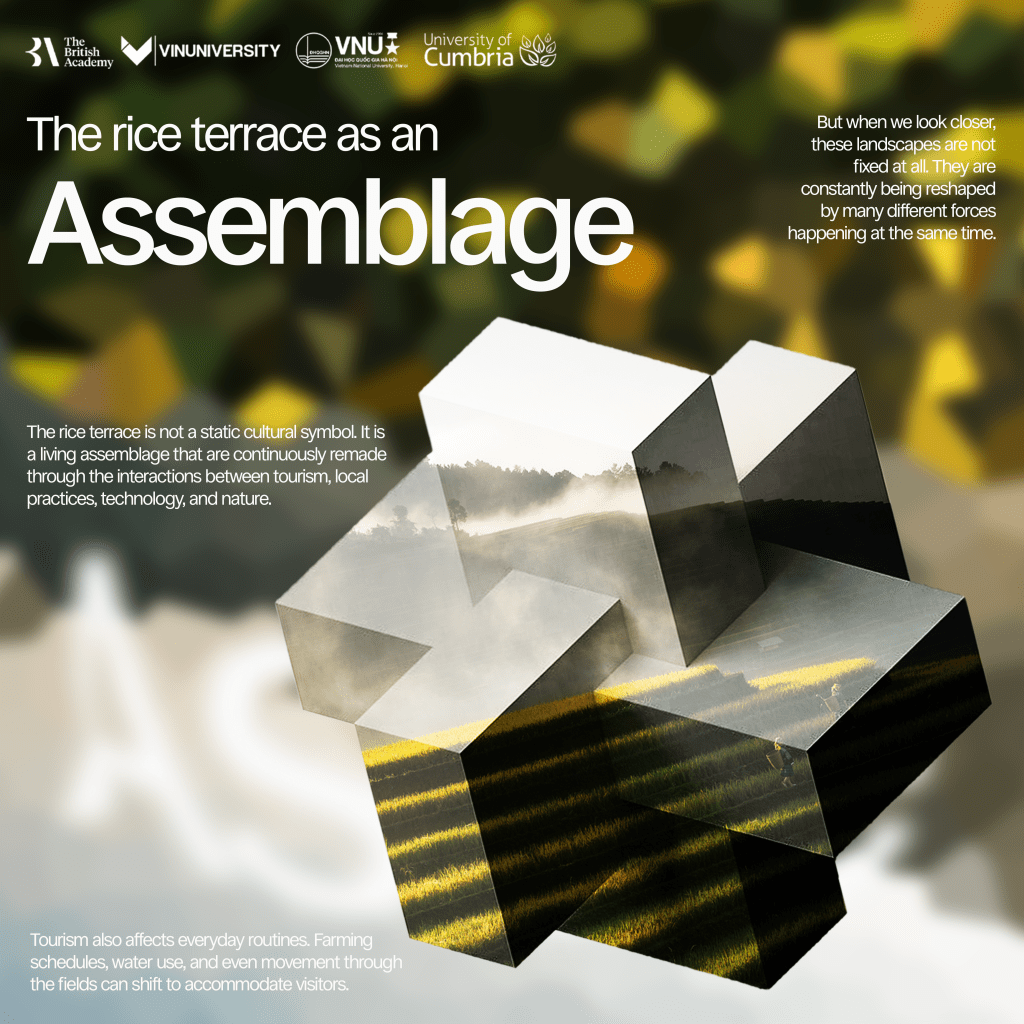
We often imagine the rice terraces as something traditional and unchanged. We see beautiful fields shaped by generations and carrying a somewhat stable identity (e.g. when looking at a photo, we can identify what is a rice terrace and what is not). But when we look closer, these landscapes are not fixed at all. They are constantly being reshaped by many different forces happening at the same time.
This is where “assemblage thinking” (Deleuze & Guattari, 1987 as cited in Dovey, 2020) can help. In simple terms, it means that something is not stable or permanent but made through changing relationships between people, tools, ideas, and environments. In the context of tourism, the rice terrace clearly shows how this works.
When visitors arrive, they don’t just “see” the terraces. They also bring expectations. Many expect perfectly ripe fields and beautiful photo spots. To meet these expectations, new elements are introduced: drones, check-in platforms, marked viewpoints, and even carefully maintained walking paths. These additions slowly change how the terraces look and function.
For example, some areas are adjusted to be more “photo-friendly.” Paths in the rice terrace are cleaned or widened, certain spots are designed for panoramic views, and timing of water flow or planting may be influenced by peak tourist seasons. In this way, the terrace is no longer shaped only by agricultural needs, but also by visual and aesthetic demands.
Technology deepens this change. Because aerial photos are popular, landscapes may be maintained in ways that look better from above. Locals may also learn photography and editing skills, turning the terrace into both a workplace and a visual product.
Tourism also affects everyday routines. Farming schedules, water use, and even movement through the fields can shift to accommodate visitors. What used to be purely agricultural space becomes a shared space between farming, tourism, and performance.
All these elements, namely tourists, technologies, infrastructures, and new ideas of beauty, enter the terrace and become part of it. And as new elements enter, others may fade or change. This is why the terrace cannot be understood as something fixed.
So instead of asking, “Is this terrace still authentic?”, maybe we should ask:
❓What changes are happening?
❓Who is shaping them?
❓ And what purposes do they serve?
Seen this way, the rice terrace is not a static cultural symbol. It is a living assemblage that are continuously remade through the interactions between tourism, local practices, technology, and nature.
_
Author: Gia Bao Tran and Tran Phuoc Lam Huy
Photo Credit: Taken by the research team
Reference:
Dovey, K. (2020). Place as assemblage. In T. Edensor, A. Kalandides, & U. Kothari (Eds.), The Routledge Handbook of Place (1st ed., pp. 21–31). Routledge. https://doi.org/10.4324/9780429453267-1
_
Vietnam Outdoor Tourism Research Project
💌Email: vietnamoutdoorresearch@gmail.com
🌐Website: https://vnort.com/
 Vietnam Outdoor Tourism Research