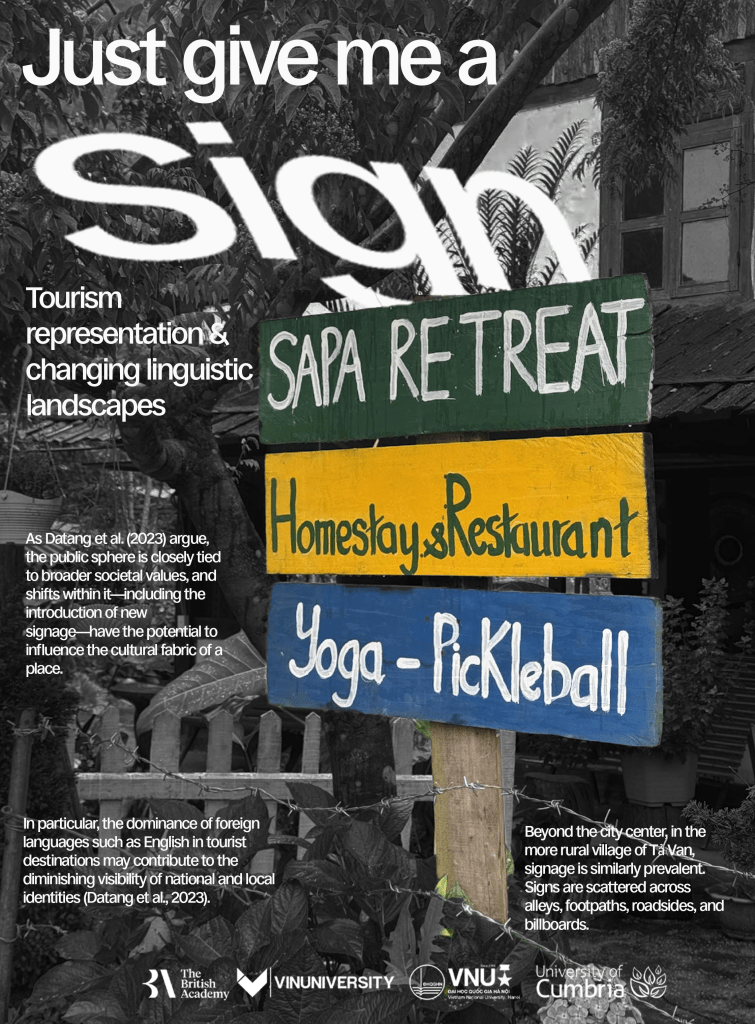
Signs scattered throughout the tourist region of Sa Pa, Vietnam, read: “Sa Pa Retreat, Homestay and Restaurant, Pickleball, Yoga,” “Cheese, Wine, Pancakes Here!,” and “Martini Bar, Kitchen, Coffee.” Others proclaim: “Juice, Beer, Cooking Class, Hot Chocolate, Family Meal” or “Indulge in Sweet Delights: Pain au Chocolat.”
Located in the mountainous northern region of Vietnam, Sa Pa has rapidly emerged as an internationally recognized tourist destination. Accelerated development, coupled with increasing tourism demand, has given rise to a proliferation of new businesses, each promoting its products and services through highly visible signage. In Sa Pa’s city center, visitors encounter an eclectic array of colorful, densely packed signs competing for attention in the public space.
Beyond the city center, in the more rural village of Tả Van, signage is similarly prevalent. Signs are scattered across alleys, footpaths, roadsides, and billboards. Tả Van has become known as a destination offering “authentic” cultural experiences, where tourists seek meaningful encounters with local ethnic minority communities. Yet as signage multiplies, its growing presence may begin to reshape the very identity of the community space that visitors initially sought to experience.
Signage—often conceptualized as part of a region’s “linguistic landscape”—reflects a diversity of languages, designs, materials, and formats. These signs are not neutral; they are constructed to attract customers, communicate value, and respond to perceived market demands. In doing so, they signal what is prioritized and considered important within a given local context. As Datang et al. (2023) argue, the public sphere is closely tied to broader societal values, and shifts within it—including the introduction of new signage—have the potential to influence the cultural fabric of a place. In particular, the dominance of foreign languages such as English in tourist destinations may contribute to the diminishing visibility of national and local identities (Datang et al., 2023).
As Vietnam continues to expand its tourism sector, important questions emerge: How does signage alter the linguistic landscape of tourism hotspots? Should signage more intentionally reflect local languages and scripts? Could visual design elements incorporate local cultural aesthetics? How do local residents perceive and experience the growing presence of commercial signage in public spaces? And how are these signs produced—handmade by local artisans or mass-manufactured elsewhere?
_
Author: Myles Lynch
Photo Credit: Taken by Myles Lynch
Reference:
Datang, F. A., Munawarah, S., Triwinarti, W., & Lauder, M. R. (2022). Signage in public spaces: Impact of tourism on the linguistic landscape of Labuan Bajo. International Review of Humanities Studies, 7(1), 92-107.
_
Vietnam Outdoor Tourism Research Project
💌Email: vietnamoutdoorresearch@gmail.com
🌐Website: https://vnort.com/
 Vietnam Outdoor Tourism Research