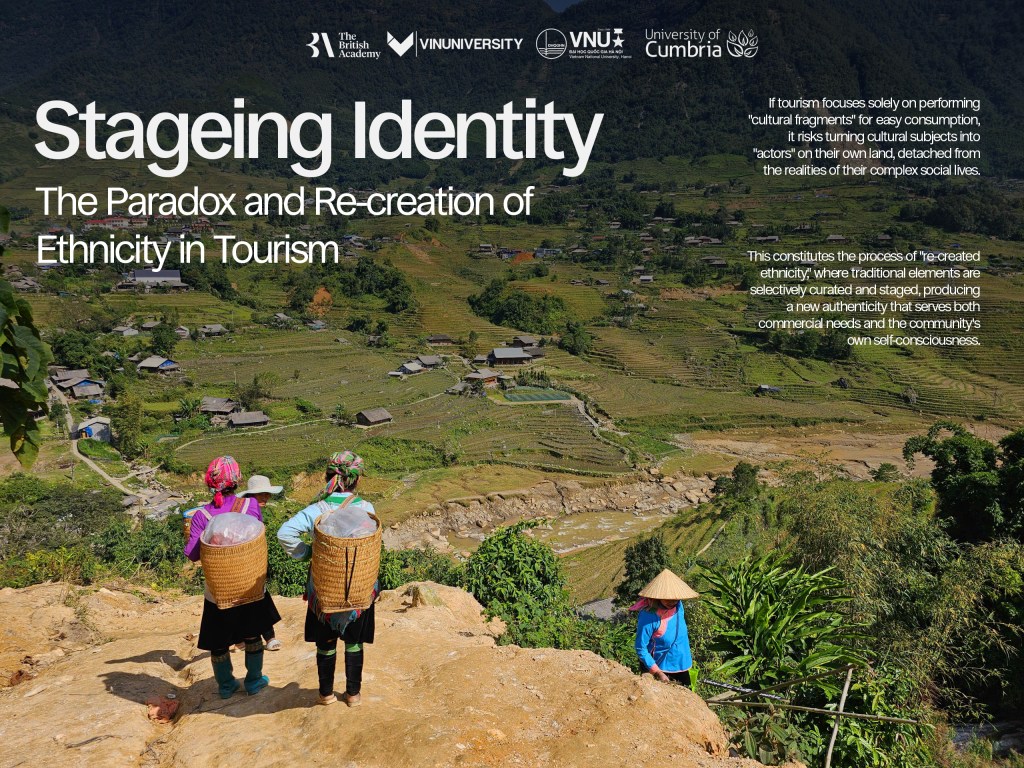
More than forty years ago, Pierre van den Berghe and Charles Keyes (1984) and authors in their edited collection laid the foundation for an astute conceptual paradigm on “ethnic tourism,” a form of social relations in which the cultural “exoticism” of the native population serves as the primary commodity. Through the lenses of sociology and anthropology, the authors sharply dissect a complex reality where tourism is not merely an industry, but a paradoxical process of “re-created ethnicity”.
The Rise of the Triadic Role Structure and the Paradox of Authenticity
Berghe and Keyes’ analytical framework centers on identifying three inseparable roles in local tourism: the tourist, the touree, and the middleman. Within this structure, the modern tourist perpetually yearns for an “authentic” experience of “unspoiled natives”. However, the authors warn of the “Heisenberg effect”: the very presence of the observer inevitably alters the observed. Once natives become conscious of the tourist gaze, they transform into “tourees” – performers who modify their own behavior to satisfy the expectations of outsiders. In this process, middlemen, ranging from travel agents to state agencies, act as architects who mold cultural stereotypes for promotion to achieve economic interests.
The Manifestation of Re-created Identities
Drawing from case studies in Southeast Asia, Micronesia, and Louisiana, Berghe and Keyes demonstrate that identity is never static but is “constructed” or reconstructed through tourist interactions. In Sulawesi, the Toraja have accepted stereotypes regarding funerals and boat-like houses, turning them into public markers for their ethnic group. Or in Micronesia, craft items that were once utilitarian have been reintegrated as cultural symbols to assert international standing. This constitutes the process of “re-created ethnicity,” where traditional elements are selectively curated and staged, producing a new authenticity that serves both commercial needs and the community’s own self-consciousness.
A Reflection on Vietnam uplands tourism
Looking back at the tourism villages in the Vietnam highlands today, this conceptual framework retains its profound analytical power. This lens helps us identify the middleman groups that shape ethnic imagery through festivals or “cultural tourism villages.” Furthermore, much like the Toraja or Cajun cases, Hmong and Dao communities in Vietnam are not merely passive victims of “commodification”. They may be undergoing a process of “re-creating ethnicity” and asserting their distinct existence and identity within a rapidly modernizing society.
However, the question of genuine narrative authority remains open. If tourism focuses solely on performing “cultural fragments” for easy consumption, it risks turning cultural subjects into “actors” on their own land, detached from the realities of their complex social lives.
_
Author: Trần Hoài
Photo Credit: Trần Hoài
References:
Van den Berghe, P.L. and Keyes, C.F., 1984. Introduction tourism and re-created ethnicity. Annals of tourism research, 11(3), pp.343-352.
_
Vietnam Outdoor Tourism Research Project
💌Email: vietnamoutdoorresearch@gmail.com
🌐Website: https://vnort.com/
 Vietnam Outdoor Tourism Research