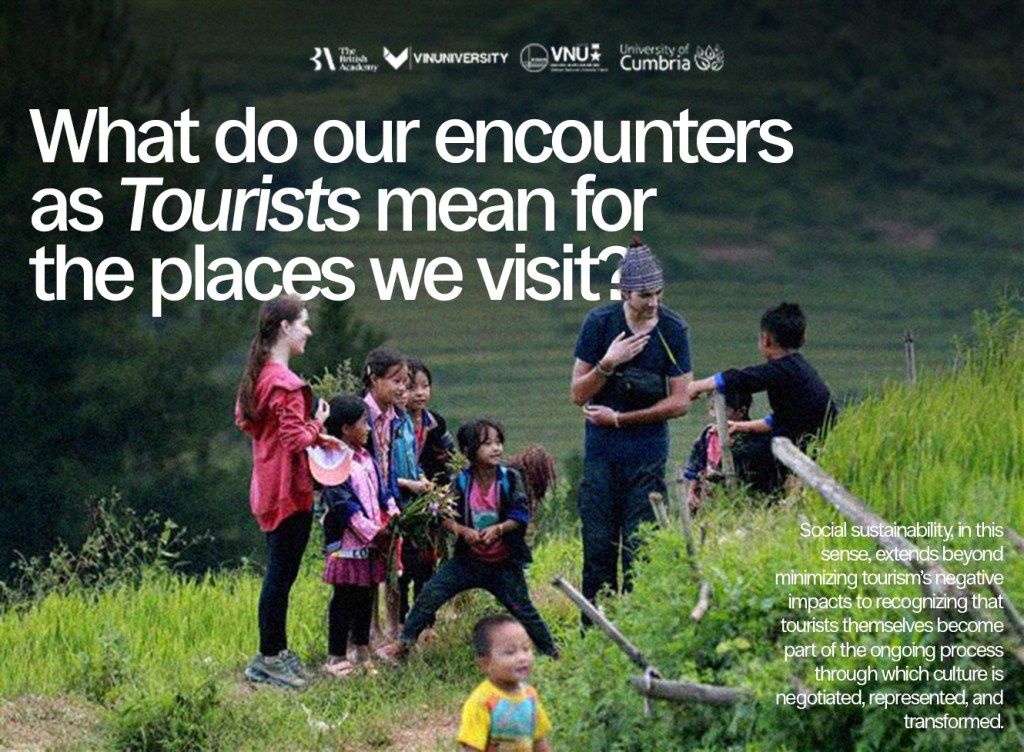
A recent study on tourism in remote communities in Vietnam invites us to look more closely at the quiet, everyday encounters between visitors and local residents. It is within these seemingly ordinary interactions that the social sustainability of tourism may actually be negotiated.
Drawing on interviews with villagers, tourists, tour guides, and tourism experts, Vu and colleagues (2024) identify a wide range of behaviors that shape tourism’s social impacts. Some actions help build positive relationships: visitors who learn local customs, participate respectfully in community life, or support local products contribute to more constructive interactions between guests and hosts.
Yet the study also reveals subtler practices that can gradually unsettle these relationships. Behaviors that may appear harmless to visitors can, over time, reshape social norms, daily routines, and power relations within host communities.
Seen from this perspective, the implications become particularly relevant for regions such as Tây Bắc. Cultural change may not occur only through large development projects, official festivals, or curated “cultural villages.” It may also emerge through thousands of small interactions unfolding in homestays, markets, village paths, and shared meals.
A photograph carefully staged for social media.
A tourist offering advice on how local food should be cooked.
A child learning that visitors often bring candy or money.
Individually, these moments may seem trivial. Yet as they accumulate, they can subtly shape expectations on both sides.
Tourism as a field of social practice
What makes these behaviors especially revealing is that they rarely arise from individual intention alone. The study shows that tourist actions are shaped by broader social forces: crowd influence, convenience, marketing narratives, and a deeply embedded service mindset in which “the customer is king.”
In this sense, tourism begins to appear less as a series of individual choices and more as a field of social practice, a space where behaviors are learned, imitated, negotiated, and normalized through interaction. Visitors observe one another, hosts adjust their responses, and tour operators or guides attempt, sometimes unsuccessfully, to regulate conduct.
Over time, these repeated encounters influence how communities present themselves, how cultural practices are interpreted, and ultimately how tourism narratives about a place are constructed. Social sustainability, in this sense, extends beyond minimizing tourism’s negative impacts to recognizing that tourists themselves become part of the ongoing process through which culture is negotiated, represented, and transformed.
_
Author: Nhi Nguyen Song
Photo Credit: Taken by Nhật Anh
Reference: Vu, A. D., Vo-Thanh, T., Nguyen, T. T. M., Bui, H. L., & Pham, T. N. (2024). Tourism social sustainability in remote communities in Vietnam: Tourists’ behaviors and their drivers. Heliyon, 10, e23619
_
Vietnam Outdoor Tourism Research Project
💌Email: vietnamoutdoorresearch@gmail.com
🌐Website: https://vnort.com/
 Vietnam Outdoor Tourism Research