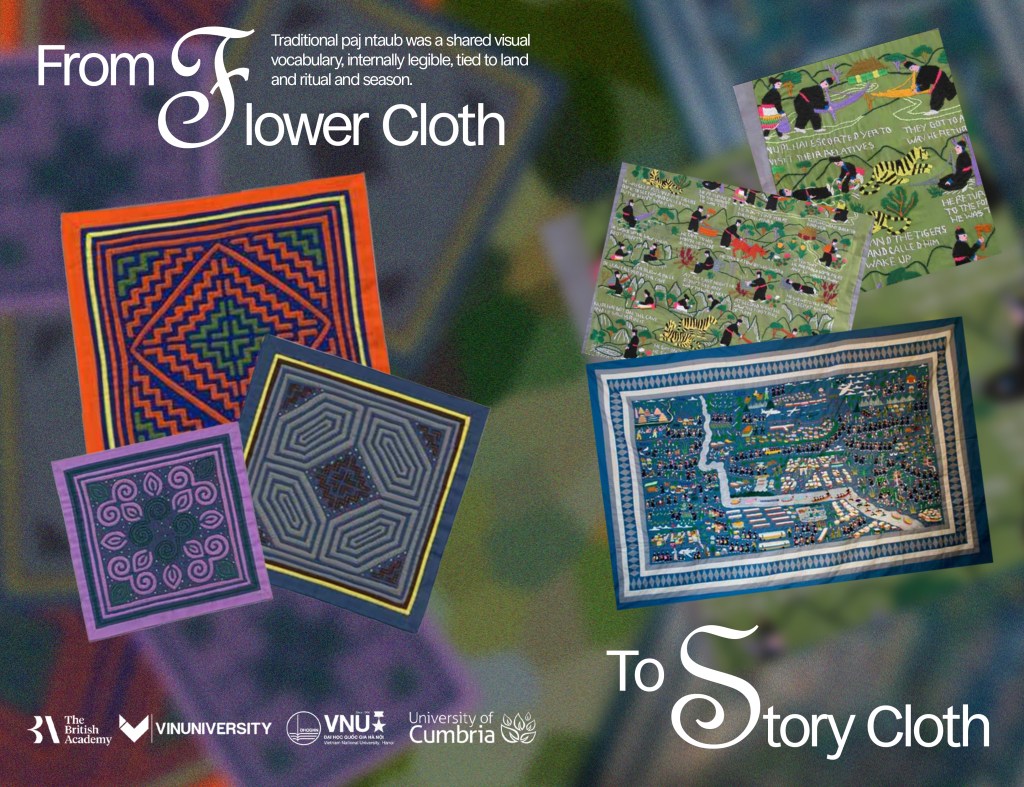
For centuries, Hmoob culture was carried in the folds of a woman’s skirt. The traditional patterns of paj ntaub (or “flower cloth”) is functional rather than decorative. Baby carriers and hats in flower cloth can “disguise the children as flowers so evil spirits will not pluck them from the earth” (Craig, 2010, p. 2). These patterns are geometric, abstract, symbolic, and understood only by Hmoob communities.
After the Secret War in Laos 1975, many Hmoob fled into refugee camps along the Thai border. There, something shifted in the textile language. A new form of paj ntaub emerged: the story cloth. Story cloths are pictorial. They depict people, landscapes, war, migration. Scenes of bombed villages, border crossings, resettlement replaced the abstraction of traditional motifs (Craig, 2010).
The shift was called “dumbing down” of visual language into a more universal, pictorial representation (Craig, 2010, p. 3). While traditional paj ntaub required a shared cultural background to decode, these story cloths were designed to be accessible to outsiders. Hmoob artist Ia Yang, who lived through the resettlement process, said that the primary impulse behind this new style was the need to document their history and plight for the rest of the world to see.
When Craig traveled to Laos and northern Thailand in 2009, she found this process well advanced. Story cloths were abundant in the tourist markets of Luang Prabang, stitched onto aprons, bags, and pillows, their subjects shifted from political history to Hmoob legend, their text always in English.
Traditional paj ntaub was a shared visual vocabulary, internally legible, tied to land and ritual and season. Displacement broke that continuity. As Craig observed these changes across the Hmoob diaspora and the markets of Southeast Asia, she grappled with the underlying motivation for such a radical aesthetic change.
_
Author: Khánh Linh Châu – Research Assistant
Photo Credit: Geraldine Craig
References:
Craig, G. (2010). Patterns of change: Transitions in Hmong textile language. Hmong Studies Journal, 11, 1–48.
_
Vietnam Outdoor Tourism Research Project
💌Email: vietnamoutdoorresearch@gmail.com
🌐Website: https://vnort.com/
 Vietnam Outdoor Tourism Research